
“We’re not tooth focused. We’re health focused.”
Crowded and crooked teeth are rarely just cosmetic concerns. In pediatric airway care, they are often visible signs of how a child’s face, jaws, and airway are developing.
When a child consistently mouth breathes, snores or breathes loudly at night, wets the bed beyond the expected age, or struggles with restless sleep or attention, pediatric sleep-disordered breathing or pediatric sleep apnea may be developing or present.
In many cases, the issue is not behavioral. It may be structural. That why we ask the important questions:
- Are the face and jaws developing in proper balance?
- Is there adequate space for stable nasal breathing during growth?
When objective findings indicate restriction, airway-focused orthodontics can guide jaw development to create the space required for consistent nasal breathing, stable sleep, and healthy growth.
Signs Your Child May Have an Airway Issue


Airway restriction reflects how the jaws are forming, how the tongue is functioning, and whether nasal breathing is supporting proper facial development.
Children rarely say, “I can’t breathe well at night.” Instead, the body shows signs of airway-related strain.
Many of the signs parents notice look behavioral at first. But when breathing is unstable, the body adapts. Those adaptations are not random. They are structural responses to restricted airflow.
Common signs of pediatric airway restriction are not random symptoms. They are patterns that reflect how a child is growing and how well their structure supports stable nasal breathing.
Common signs include:
Sleep-Related Signs
- Loud breathing or snoring during sleep
- Fragmented sleep
- Bedwetting beyond the expected age
Breathing Patterns
- Mouth breathing
- Reduced nasal breathing
Behavior & Daytime Function
- Difficulty focusing
- ADD/ADHD-like symptoms
- Morning fatigue or irritability
Growth & Structural Indicators
- Early crowding of baby teeth
- Narrow palatal width
- Limited tongue space
- Low tongue posture or limited tongue mobility (including posterior tongue tie)
- Reduced nasal volume
- Reduced minimum cross-sectional airway size
- Enlarged tonsils or adenoids
- Forward head posture
- Teeth grinding (bruxism)
- Dark circles under the eyes
If you are seeing these symptoms in your child, it is reasonable to ask whether structure is contributing.
The Nose Is Designed For Breathing
The mouth is designed for eating, drinking, and speaking. Breathing through the mouth is designed to function as a backup system, not the primary pathway.
When a child consistently relies on mouth breathing, it often signals that nasal airflow is restricted. The body adapts to preserve oxygen intake, but that compensation changes how the tongue rests, how the jaws develop, and how the face grows.
Over time, this pattern can affect sleep stability, jaw position, facial development, and even posture.
The goal is not to eliminate the backup system. The goal is to restore the primary design so habitual nasal breathing can support healthy growth as intended.
The Tongue is the Instrument of Facial Growth & Airway Development
Nearly half of facial development occurs within the first two years of life. This period plays a foundational role in how the face, jaws, and airway form.
One of the most important ideas to understand is this: the roof of the mouth also forms the floor of the nose.
When the tongue rests upward and forward against the roof of the mouth, it provides the natural stimulus for the upper jaw to widen. As that widening happens, the nasal airway widens with it which makes habitual nose breathing more intuitive and natural.
On the other hand…
If the tongue cannot reach the roof of the mouth due to structural issues, low oral muscle tone, or posterior tongue tie, the upper jaw may develop narrow.
A narrow upper jaw often results in a narrower nasal airway. When nasal airflow is restricted, the body often adapts by mouth breathing.
What Happens When Growth Is Restricted
Jaw development follows a predictable growth pattern. The earlier restriction is identified, the more conservative and effective treatment options tend to be. Early identification gives us the opportunity to support optimal growth instead of managing restrictions and compensations.
When the upper jaw does not widen as it should during development:
- The nasal cavity narrows, reducing stable nasal airflow
- The tongue loses space to rest upward against the palate
- Airflow becomes unstable, increasing the likelihood of mouth breathing and sleep disruption
- The lower jaw may posture further back, reducing overall airway space
- Sleep may become lighter and more fragmented, limiting restorative rest
That is why we measure right away.
Early measurement provides clarity for what course of treatment will give us the best chance at an optimal outcome.
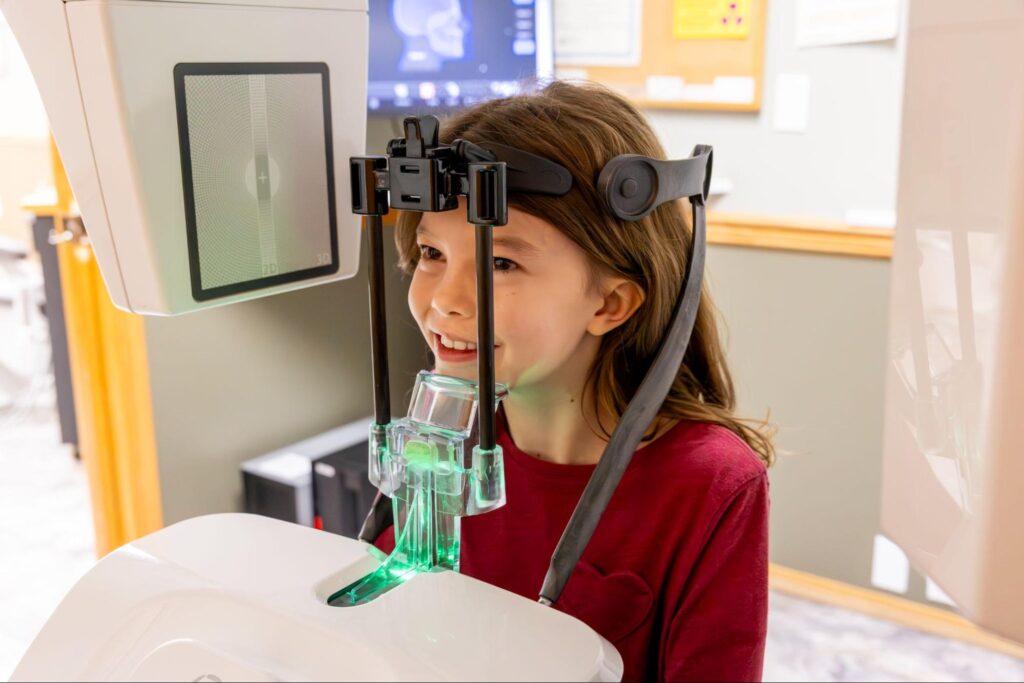
What We Measure in Children
We do not rely solely on visual examination. Pediatric airway evaluation includes objective measurements of nasal airway size, jaw development, and tongue space to determine whether structure is limiting breathing.
In children, we measure objectively, track change, and documented structural improvement of these data points:
- Minimum cross-sectional area of the nasal airway
- Total nasal volume
- Palatal width
- Nasal floor width
- Mandibular position
- Tongue space and posture
- Oral airway space
- Growth stage and developmental timing
Data Matters
We collect measurable airway data on every pediatric patient before recommending treatment.
A two-year-old typically measures approximately three millimeters at the narrowest part of the nasal airway. Many symptomatic children measure below this threshold. A one-millimeter difference in a small pediatric airway can represent a meaningful percentage change in airflow capacity.
In our practice analysis of hundreds of growing patients, early expansion has produced average increases of approximately 42–46 percent in minimum nasal airway size, with many children experiencing even greater improvement.
Growth stage matters because treatment depends on how much growth we still have to work with. About 50 percent of facial growth is complete by age 2, and by age 12 that number is closer to 80 percent.
The earlier we understand what is happening, the more options we have and the simpler those options tend to be.
Treatment Options for Children
Not every child needs treatment.
Some children measure within stable ranges and simply need monitoring as they grow. Intervention is recommended only when objective findings show that structure is limiting healthy nasal breathing or normal jaw development.
Treatment options may include:
- Tongue Or Lip Tie Release: Often recommended when a restrictive frenulum prevents the tongue from resting fully against the palate.
- Early Palatal Expansion: Widens the maxilla at the skeletal level and increases nasal airway volume.
- Growth Guidance Orthodontics: Influences jaw position and facial balance before maturation.
- Myofunctional Therapy: Retrains facial muscles and reinforces nasal breathing patterns.
What Parents Often Notice
When we create the structural space for stable nasal breathing during growth, the changes in children are often profound.
Parents often report:
- Quieter, more stable sleep
- Reduced or eliminated snoring
- Closed mouth breathing with improved nasal airflow
- Fewer nighttime awakenings
- Improvement or resolution of bedwetting
- Better daytime focus and attention
- More consistent morning energy
- Reduced teeth grinding
- Improved posture
- Calmer overall behavior
Frequently Asked Questions
What are the signs of pediatric airway restriction?
Common signs include mouth breathing, snoring, restless sleep, bedwetting, difficulty focusing, teeth grinding, dark circles under the eyes, and forward head posture.
Can mouth breathing affect my child’s facial growth?
Yes. Chronic mouth breathing can influence how the face and jaws develop.
Is snoring in children normal?
No. Snoring can indicate airway restriction and should be evaluated.
What is the connection between tongue tie and airway development?
Tongue restriction can limit proper jaw growth and reduce airway space.
At what age should a child be evaluated for airway concerns?
Airway concerns can be evaluated at any age, including infancy.
Schedule a Pediatric Airway Evaluation
If you are concerned about your child’s breathing or sleep, we invite you to schedule a Pediatric Airway Evaluation. We welcome patients from Lewiston, Moscow, Grangeville, and throughout North Central Idaho, as well as from across the United States, Canada, and beyond