
Don’t Ignore Early Crowding: It Can Be a Sign the Upper Jaw Isn’t Developing Properly


When a child’s upper jaw doesn’t develop properly, it affects more than teeth.
An underdeveloped upper jaw may contribute to crossbite, crowding, mouth breathing, forward head posture, and unstable sleep.
What often appears to be “just crooked and crowded teeth” can be a visible sign that facial growth, jaw development and airway health are being compromised.
Early palatal expansion allows us to guide anatomical development while the child is still growing.
The goal of palatal expansion are balanced facial development, optimal jaw growth, a healthy airway and straight teeth.
Early correction of structural restrictions improves alignment and removes obstacles to a child’s comfort, function, and overall well-being as they grow.
As breathing becomes easier and the bite stabilizes, many families report deeper, quieter sleep, fewer nighttime awakenings, less snoring and mouth breathing, reduced jaw tension and teeth grinding, fewer morning headaches, and less daytime irritability in their children.
Why Early Expansion Matters
The upper jaw is most responsive to orthopedic guidance during childhood.
About 50 percent of facial growth is complete by age two. By age twelve, approximately 80 percent is complete.
During early childhood, the natural growth seam between the two halves of the upper jaw (the mid-palatal suture) has not yet fused. That allows us to widen the jaw gently at the skeletal level.
Some of the benefits of early palatal expansion include:
- Predictable Crossbite Correction: Crossbites can be corrected more reliably during growth.
- Reduced Future Crowding: Creating space early may prevent or reduce crowding.
- Room for Nasal Breathing: Supports healthier breathing patterns.
- Simpler Future Orthodontics: Treatment may be reduced or avoided.
- Optimal Jaw Development: Supports skeletal development, not just teeth alignment.
- Optimal Airway Development: Supports breathing and sleep quality.
- Long-Term Stability: Reduces relapse risk.
Waiting until adolescence or adulthood changes the mechanics entirely. Once growth slows, options narrow.
What Happens When the Upper Jaw Is Too Narrow?
When the upper jaw does not develop to its full potential, it changes how the teeth erupt, how the lower jaw positions itself, and how the tongue and airway function.
Some of the structural consequences may include:
- Posterior Crossbite: Upper teeth sit inside lower teeth, affecting growth.
- Crowded Teeth: Limited space affects eruption.
- Lower Jaw Compensation: Jaw shifts backward or sideways.
- Reduced Tongue Space: Affects breathing and development.
- Poor Oral Posture: Leads to long-term strain.
These conditions tend to worsen over time and rarely improve on their own.
When the upper jaw remains narrow, nasal airflow is restricted and mouth breathing may become habitual.
Expansion is recommended only when objective findings show structural restriction.
How a Palate Expander Actually Works
True orthopedic expansion gently separates the two halves of the upper jaw at the natural growth seam.
As the suture opens, the body grows new bone between the two halves, permanently increasing skeletal width.
The goal is stable, biologic change at a pace that supports an optimal outcome.
Our approach includes:
- Gentle, Gradual Activation: Allows proper adaptation.
- Biology-First Bone Formation: Supports stability.
- Reduced Side Effects: Avoids excessive force.
- Predictable Long-Term Results: Improves outcomes.
We follow protocols designed to work with growth, not against it.
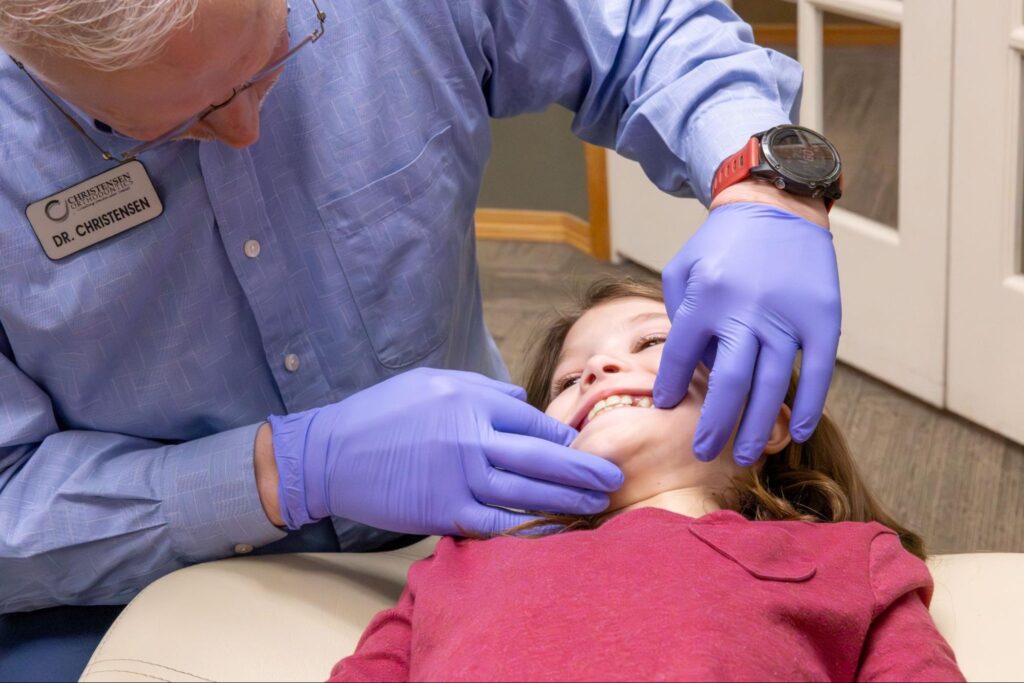
What to Expect During Pediatric Expansion
Timing
As soon as symptoms which can be as early as 2.5 – 3 years old.
Comfort
Mild pressure for a few days that resolves quickly.
Duration
Active expansion lasts weeks; stabilization lasts several months.
Front Tooth Gap
A temporary gap is normal and expected.
Adjustment Period
Minor speech and eating changes resolve quickly.
Frequently Asked Questions
What age is best?
As early as possible, between 2 1/2-3 years old.
Can it fix crossbite?
Yes, very predictably during growth.
Will it prevent extractions?
Often reduces the need, depending on growth.
Does it help breathing?
Yes, when airway restriction is present.
How long does it take?
Weeks for expansion, months for stabilization.
Is the gap permanent?
No, it typically closes naturally.
Why We Do Not Suggest “Watchful Waiting”
As children grow, the suture becomes less responsive. Delaying evaluation can limit conservative options.
Early assessment provides clarity while growth is still on your side.
Next Steps
If your child has early crowding, a crossbite, or a narrow upper jaw, an early evaluation at our Lewiston, Idaho practice provides clarity and a clear path forward. The earlier we understand your child’s development, the more conservative and predictable treatment becomes. We welcome patients from throughout North Central Idaho and from across the United States, Canada, and beyond.