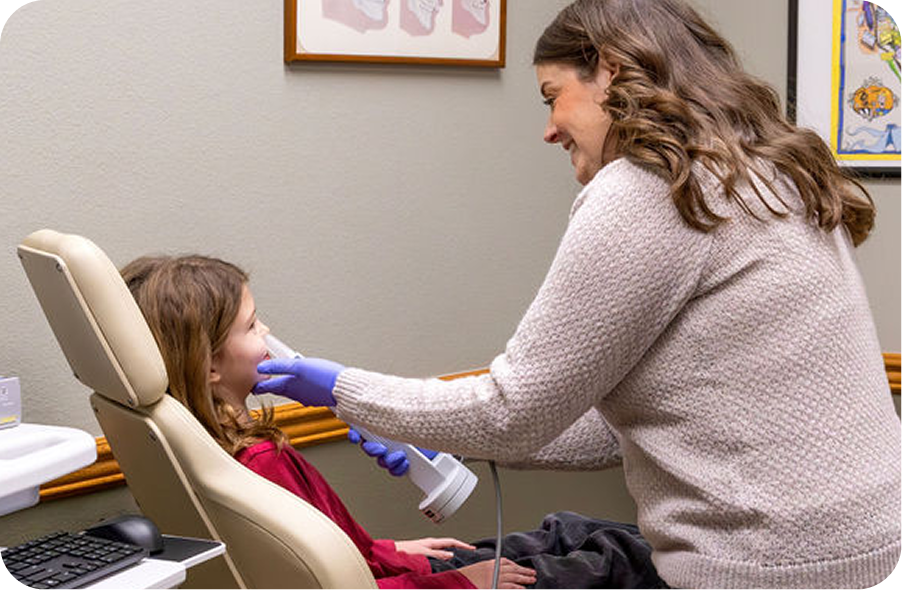
Airway orthodontics focuses on how airway development, habitual nasal breathing, proper jaw growth, and high-quality sleep influence long-term health.
As a board-certified orthodontist and dental sleep-medicine specialist, Dr. Bret Christensen incorporates airway evaluation into orthodontic planning.
Treatment is structured. Measurements are taken before and after care, and decisions are guided by objective findings.
The roof of the mouth is also the floor of the nose. When the upper jaw does not develop properly, nasal airflow is restricted.
Mouth breathing becomes a common compensatory response. When breathing is compromised, the body adapts. Over time, this can negatively influence facial growth, sleep quality, and overall health.
Habitual nasal breathing supports optimal development of the airway, face, and jaw. In most cases, this contributes to both more stable orthodontic results and better overall health.

01
Children may develop narrow arches, crowded teeth, bedwetting, night terrors, or difficulty focusing.
02
Adults may experience snoring, fatigue, jaw tension, or (often un-diagnosed) obstructive sleep apnea.
We screen for airway-related health compromises.
We assess the airway using objective structural measurements.
We design treatment based on structural findings and airway data.
We create space when and where it is needed.
We align the teeth to create healthy, stable, and beautiful smiles.
We evaluate outcomes over time.
For children, early orthopedic expansion supports jaw development and reduces the likelihood of extractions later.
For adults, MARPE/MAPDO and other non-surgical techniques can reshape the craniofacial structure itself, improving nasal airflow rather than simply managing symptoms.
The goal is not only to manage symptoms with a device. The goal is to evaluate and improve the structure that supports healthy breathing.
Since 2013, Dr. Christensen and his team have tracked airway changes across hundreds of patients in North Central Idaho and beyond. They have analyzed more than 300 cases to understand measurable outcomes.
Here are some highlights of what the data shows:
These Improvements Translate Into Meaningful Changes for Children And Adults.
Each percentage point reflects measurable shifts in airflow, oxygen stability, and sleep quality.
FOR CHILDREN
Increased airway space may support deeper, more stable sleep, improved oxygen levels, fewer nighttime disruptions, and better daytime focus. Parents often report calmer mornings and growth patterns that appear more balanced. Expansion is not only creating room for teeth. It may also create space for healthier development.
FOR ADULTS
Increased nasal volume and reduced AHI may support quieter sleep, less snoring, more restorative rest, improved energy, and reduced strain on the cardiovascular system. Rather than only managing symptoms with a device, treatment may address structural restriction contributing to fatigue and airway instability.
Children benefit from early evaluation because growth is still unfolding. Expansion during development can increase space for both air and permanent teeth.
Adults can also benefit from airway-focused care. Implant-supported expansion such as MARPE/MAPDO for Adults may increase nasal space and reduce airway restriction without surgery.
Airway orthodontics evaluates how airway health affects jaw development, tooth alignment, breathing and sleep. It considers structure, airflow, and growth patterns in addition to cosmetic alignment.
Common signs may include mouth breathing, snoring, restless sleep, bedwetting, early crowding, and difficulty focusing. A comprehensive airway evaluation can help determine whether structural factors are involved.
Traditional orthodontics focuses primarily on aligning the teeth. Airway-focused orthodontics also evaluates nasal airflow, jaw development, facial structure, and airway anatomy to understand how they may be influencing breathing, sleep quality, and healthy growth in children.
Yes. Adults with snoring, diagnosed sleep apnea, jaw tension, or chronic fatigue may benefit from evaluation to determine whether craniofacial structure contributes to airway restriction.
Increasing space within the upper jaw can improve nasal airflow and support healthier breathing patterns. Outcomes vary based on age, anatomy, and overall health.
Treatment decisions are guided by objective measurements and tracked outcomes over time. Airway-focused care incorporates imaging, sleep data and structural evaluation to support clinical planning.
If you are seeking an airway-focused orthodontist in Idaho who incorporates structured diagnostics, objective measurement, and airway-centered planning into every phase of care, we invite you to schedule a comprehensive airway evaluation. We welcome patients from Lewiston, Moscow, Grangeville, and throughout North Central Idaho, as well as from across the United States, Canada, and beyond.