
The Restriction You Have Been Compensating For Your Entire Life
You have probably never been told you might have a tongue tie.
Most adults haven’t. The conversation around tongue restriction has historically focused on infants and children. But the tissue does not disappear with age. If your tongue was restricted at birth, it is still restricted now. The difference is that your body has spent decades learning to work around it.
That compensation is not free. It shows up in ways most people never connect to the tongue:
- Chronic jaw tension or clenching
- Teeth grinding, especially at night
- Joint clicking or TMJ discomfort
- Habitual mouth breathing
- Dry mouth upon waking
- Snoring or fragmented sleep
- Daytime fatigue that sleep does not seem to fix
- Forward head posture
- Neck and shoulder tension that never fully resolves
If several of these sound familiar, the tongue may be part of a structural pattern that has been quietly shaping your health for years.
How a Tongue Tie Affects Adults Differently


In children, tongue restriction affects growth. The jaws are still forming, and the tongue’s inability to rest against the palate can change the trajectory of facial development.
In adults, growth is complete. The structural consequences of restriction are already established. What remains are the compensation patterns: the muscles that overwork to stabilize the jaw, the breathing habits that developed to maintain oxygen, and the sleep disruption that follows when the airway is structurally narrow.
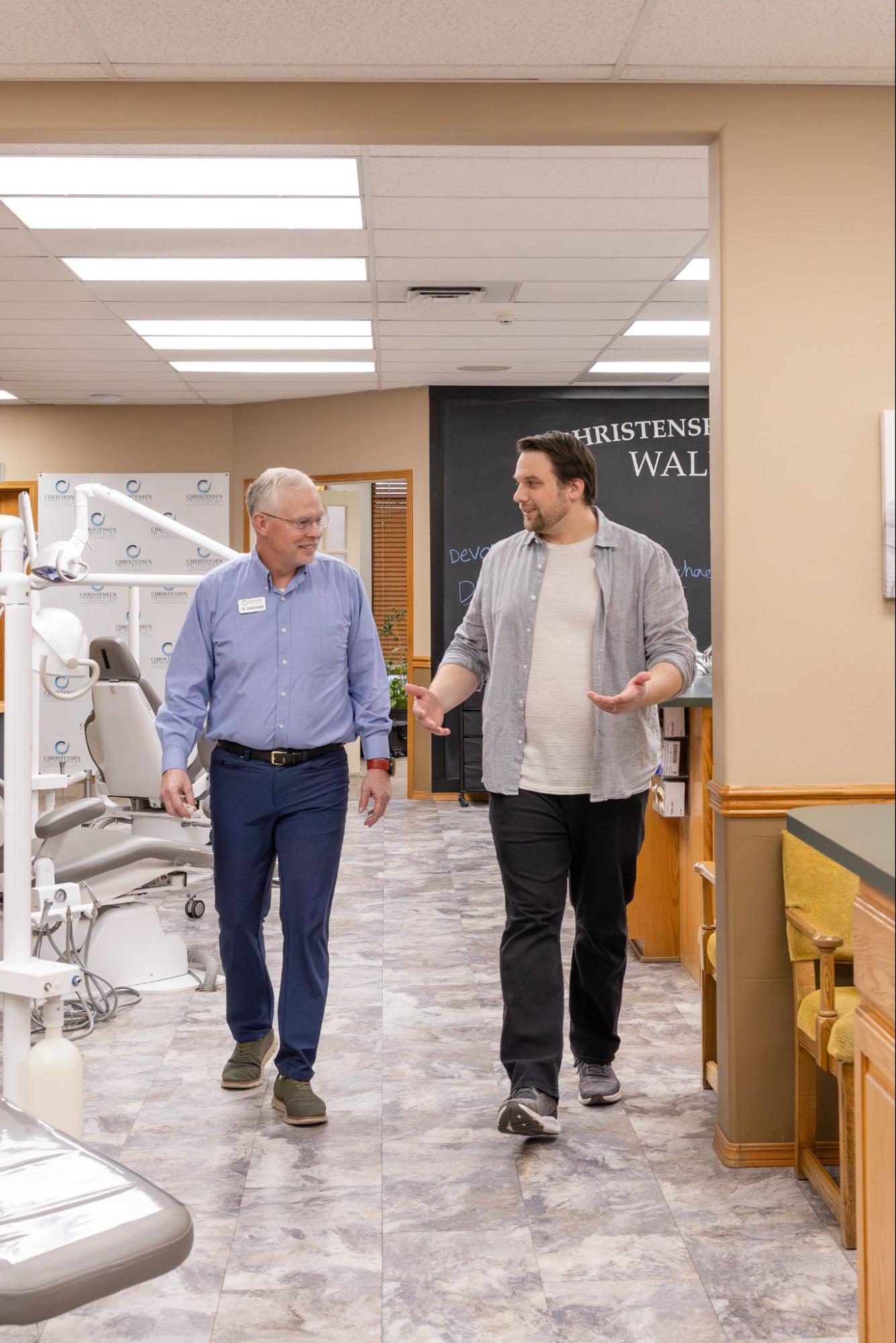
Dr. Christensen understands this on a personal level. He was diagnosed with obstructive sleep apnea years before he connected the dots between jaw structure, airway restriction, and the symptoms he had been managing with appliances. After a heart attack forced him to look deeper, he underwent structural expansion himself. His most recent sleep study shows zero apnea events.
That experience changed how he practices. It is why every adult who walks into this office is evaluated structurally before any treatment recommendation is made.
The Tongue, the Jaw, and the Airway
In adults, tongue restriction is rarely an isolated problem. It exists within a larger structural story.
When the tongue could not rest against the palate during childhood, the upper jaw may not have widened fully. A narrow upper jaw means a narrow nasal floor. A narrow nasal floor means reduced nasal airway space. Reduced airway space means the body compensates, often by breathing through the mouth, posturing the head forward, and clenching the jaw to stabilize the airway during sleep.
Over time, these compensations become invisible. They feel normal because they have always been there. But they are not neutral. They contribute to fatigue, tension, pain, and sleep quality that never quite reaches restorative.
Understanding how the tongue fits into this chain is the first step toward deciding whether intervention makes sense.
How We Evaluate Tongue Tie in Adults
We do not evaluate tongue restriction in isolation. In adults, the question is not simply “is there a tie?” The question is whether that restriction is contributing to structural limitation, airway compromise, or functional symptoms that affect quality of life.
Our evaluation includes:
- Tongue mobility: Can the tongue elevate fully to the palate without strain or compensation?
- Resting tongue posture: Where does the tongue naturally sit when you are not thinking about it?
- Jaw structure: Is the upper jaw narrow? Is there evidence of skeletal restriction?
- Airway assessment: What do nasal volume, cross-sectional area, and airflow resistance look like?
- Sleep patterns: Is there snoring, apnea, or fragmented sleep that may relate to structural narrowing?
- Compensation patterns: Are there signs of chronic clenching, grinding, tension, or postural adaptation?
When tongue restriction is present alongside narrow jaw structure and airway compromise, it becomes part of a treatment conversation that may also include skeletal expansion (MARPE/MAPDO) and myofunctional therapy.
When tongue restriction is present but the jaw, airway, and sleep are within stable ranges, we may recommend monitoring rather than intervention.
The goal is not to treat every tongue tie. The goal is to understand whether yours is contributing to the symptoms that brought you here.
When We Recommend a Release
A frenectomy is recommended when evaluation confirms that restriction is meaningfully limiting tongue mobility and contributing to structural, airway, or functional problems.
We use CO₂ laser technology for precise, controlled release with minimal tissue trauma. The procedure is brief. Recovery is generally straightforward, with some soreness for a few days.
But the release itself is not the outcome. It is the starting point.
Myofunctional Therapy: Retraining Decades of Compensation
An adult tongue tie release without myofunctional therapy is an incomplete treatment.
Your tongue has been compensating for restriction since birth. The muscles of the mouth, jaw, face, and throat have patterned themselves around that limitation for twenty, thirty, forty years or more. Cutting the tissue does not automatically undo those patterns.
Myofunctional therapy is a structured program of exercises designed to:
- Retrain tongue posture so the tongue learns to rest against the palate consistently
- Strengthen the muscles that support proper swallowing, lip seal, and nasal breathing
- Protect the release by maintaining mobility during healing and reducing the risk of scar tissue re-restriction
- Support nasal breathing as the primary pathway, replacing habitual mouth breathing patterns
In our practice, myofunctional therapy is not a suggestion. It is part of the treatment plan. Without it, the release may provide temporary improvement that does not hold.
How Tongue Tie Connects to MARPE/MAPDO and Structural Expansion
For many adults, tongue restriction and a narrow upper jaw are two sides of the same structural story. The tongue could not provide the widening stimulus during growth, so the palate stayed narrow. Now the nasal airway is restricted, sleep is compromised, and the body has been compensating for decades.
When both are present, treatment may involve:
- Tongue tie release to restore mobility
- Myofunctional therapy to retrain posture and breathing patterns
- MARPE/MAPDO (skeletal expansion) to widen the upper jaw at the bone level, increasing nasal volume and airway space
The sequence matters. Release gives the tongue the ability to move. Therapy teaches it where to go. Expansion creates the space it needs to stay there.
This combined approach is what distinguishes structural airway care from simply “clipping a tie.” Each step is measured, each outcome is tracked, and the treatment plan is built around your specific anatomy.
When We Do Not Recommend a Release
Not every adult with a visible or palpable frenulum needs treatment.
We do not recommend a frenectomy when:
- The tongue can elevate fully to the palate without compensation
- Jaw structure and airway dimensions are within stable ranges
- Sleep quality is consistent and restorative
- There is no measurable connection between the restriction and presenting symptoms
A tongue tie that is anatomically present but functionally insignificant does not require intervention. Our responsibility is to treat restriction that is affecting your health, and to leave anatomy alone when it is not.
What Adults Often Experience After Treatment
When structural restriction is addressed, compensation patterns retrained, skeletal space created, adults often report:
- Reduced jaw tension and clenching
- Less teeth grinding at night
- Quieter, more stable sleep
- Improved nasal breathing
- Less morning dry mouth
- Decreased daytime fatigue
- Reduced neck and shoulder tension
- A general sense that something has shifted, that the body is working less hard to do basic things
These changes do not happen overnight. Structural adaptation takes time. Muscle retraining takes consistency. But when the foundation changes, the compensations that built up over a lifetime begin to unwind.
This Is Not Where Most People Start
Most adults do not walk into our office asking about tongue ties. They come in because of jaw pain, or sleep apnea, or a CPAP they cannot tolerate, or fatigue that no amount of sleep seems to fix.
The tongue tie, if it is part of the picture, usually reveals itself during a comprehensive evaluation. It is one piece of a structural puzzle that may also include narrow jaw development, airway restriction, and sleep disordered breathing.
If you have been managing symptoms without understanding the structure behind them, a Comprehensive Airway Evaluation at our Lewiston, Idaho practice can provide the clarity you have been looking for. We measure what we can, explain what we find, and help you decide whether structural treatment makes sense for where you are in life. We welcome patients from throughout North Central Idaho and from across the United States, Canada, and beyond.