
Why a Full Airway Evaluation Matters
Airway orthodontics looks beyond tooth alignment to identify the structural drivers of oral and systemic dysfunction.
Habitual nasal breathing supports overall wellness & depends on healthy anatomical structure.
For children, early airway screening reveals whether growth is unfolding optimally or being restricted.
For adults, a structural evaluation often uncovers contributors to snoring, jaw tension, unstable sleep, or obstructive sleep apnea.
When teeth are straightened without evaluating structure, the underlying cause remains untreated. Over time, symptoms may persist or progress.
A Comprehensive Airway Evaluation grounds treatment in objective findings. We identify structural root causes and design a customized plan to support both health and alignment.
How We Evaluate Airway Structure
A Comprehensive Airway Evaluation combines symptom screening, structural examination, and specific, objective measurements of anatomical structures.
Symptom Screening
We review health and sleep symptoms, including:
- Snoring
- Sleep quality and restfulness
- Daytime focus
- Mouth breathing
- Bedwetting
- Behavioral or attention concerns
- Jaw pain or tension
- Headaches
- Blood pressure concerns
- Prior sleep apnea diagnosis
These findings help determine how airway instability may be impacting overall health.
Structural Examination
We assess craniofacial structure, including:
- Palatal width
- Upper jaw position
- Lower jaw position
- Tongue space
- Facial growth pattern
- Signs of habitual mouth breathing
In many patients, the upper jaw is the structural driver and the lower jaw adapts around it. Identifying restriction guides orthodontic treatment planning.
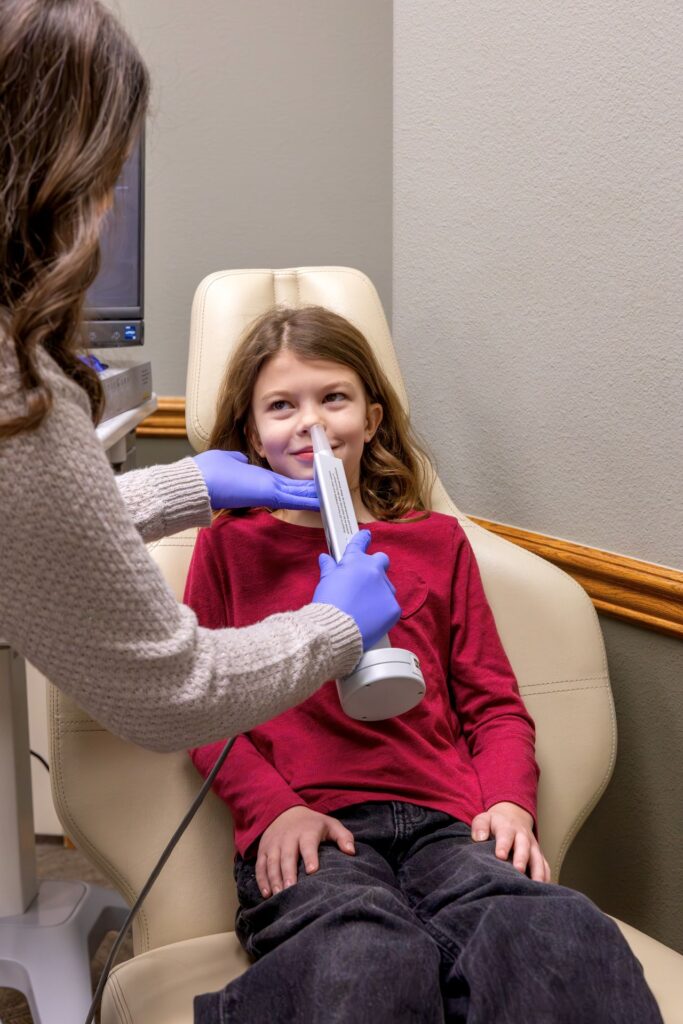
Objective Airway Measurements
An airway evaluation is not based on impression alone. We establish measurable baselines before recommending treatment.
- Minimum Cross-Sectional Area of the Nasal Airway: measures the narrowest airflow point.
- Nasal Volume: reflects total nasal airflow space.
- Nasal Floor Width: evaluates structural nasal development.
- Palatal Width: influences alignment of teeth and airway space.
- Mandibular Position: influences lower jaw adaptation.
- Tongue Space & Posture: influences functional airway stability.
- Oral Airway Volume: measures space behind the tongue.
- Tonsil & Adenoid Assessment: identifies soft tissue restriction.
- Growth Stage & Developmental Timing: determines whether intervention or monitoring is appropriate.
Advanced Imaging & Diagnostics
We use advanced tools to visualize and quantify anatomical structures, including the airway.
Diagnostics are individualized and can include:
- CBCT 3D Imaging: three-dimensional evaluation of jaw structure, nasal cavity, and airway space.
- Acoustic Rhinometry: measures minimum cross-sectional area and nasal volume.
- Pharyngometry: evaluates oral airway space behind the tongue.
- Home Sleep Study: assesses apnea events and oxygen levels.
- Pulse Oximetry: monitors oxygen saturation patterns during sleep.
The goal is clarity, not unnecessary testing.
What Happens After the Evaluation
A full airway evaluation identifies structural restriction, clarifies the drivers behind symptoms, and establishes a measurable plan for what to do next.
It answers critical questions:
- Is growth unfolding normally or being restricted?
- Are symptoms tied to measurable structural limitations?
- Is intervention needed now, later, or not at all?
- What type of treatment would address the root cause?
Rather than relying on assumptions, we establish objective baselines and translate those findings into clear recommendations.
That may include growth guidance, orthodontic expansion, adult structural treatment, collaboration with other providers, or structured monitoring over time.
Growth Stage & Treatment Strategy
- Early Childhood: growth guidance may positively influence development.
- Adolescence: treatment is guided by skeletal maturity.
- Adults: structural modification is considered when clinically indicated.
Not every evaluation leads to treatment. When measurements fall within stable ranges, monitoring may be appropriate.
Intervention is determined by measurable findings, not guesswork.
What You Leave With
At the end of your Comprehensive Airway Evaluation, you receive:
- Objective baseline measurements
- A visual review of imaging and airway data
- A clear explanation in plain language
- A structured next-step recommendation
- A monitoring or treatment plan
- Time to ask questions
There is no pressure to proceed immediately. The purpose of evaluation is understanding.
We measure.
We explain.
We plan deliberately.
Frequently Asked Questions
What is included in an airway evaluation?
Health and sleep screening, structural examination, objective airway measurements, and imaging.
Do you use CBCT for airway evaluation?
Yes, to assess jaw structure and airway dimensions.
How do you measure airway size?
We measure minimum nasal cross-sectional area, nasal volume, palatal width, and oral airway dimensions.
Can an airway evaluation detect sleep apnea?
It identifies structural risk factors. A home sleep study or pulse oximetry may be recommended.
What happens after the evaluation?
You receive a clear explanation and recommendation, which may include monitoring, growth guidance, structural treatment, or referral.
Do I need a referral?
No referral is required. Patients may contact our office directly to schedule an Airway Evaluation.